
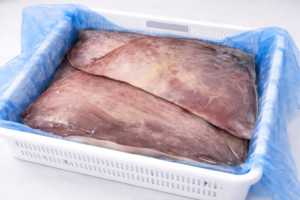
Aleta de Jibia Crudo Congelado
Dosidicus gigas
SS-JIB-ALE-001Product Identification
| Product | Raw frozen squid fin/wing |
| Species | Jumbo flying squid / Humboldt squid |
| Scientific Name | Dosidicus gigas |
| Processing Type | Raw and frozen in block |
| Presentation | Raw squid fins/wings, with skin, with cartilage, frozen in block, no glazing |
| Net Weight | Bloque 10kg congelado (20kg neto: 2x10kg) |
| Caliber (g) | SIN CALIBRE |
| Packaging | Block of 10kg wrapped in blue polyethylene film and placed in polyethylene bag of 20kg net (2x10kg) |
| Target Market | Markets with and without sanitary certification through quality assurance program (PAC) |
| End Use | Human consumption |
Label Information
| Trade Name | Raw frozen squid fin/wing |
| Scientific Name | Dosidicus gigas |
| Shelf Life | 24 months |
| Authorization No. | 4265 |
| Origin | CHILE |
| Storage Conditions | -18 °C |
| Recommendations | Keep frozen at -18°C. Once thawed do not refreeze. Consume cooked. Plant storage: -25°C. |
Sensory Examination
| Parameter | Standard |
|---|---|
| Species | Humboldt squid (Dosidicus gigas) |
| Presentation | Corresponds to that declared by the exporter and must include all aspects indicated. |
| Appearance | The product is well preserved, with normal appearance. No dehydration in more than 10% of the surface, no foreign matter or gelatinous alterations affecting more than 5% by weight. |
| Parasites | Absence of visible parasites and their cysts. |
| Odor | Normal, characteristic of the species. No abnormal aromas, decomposition or rancidity. |
| Color | Natural, typical of the species. |
| Texture | Turgid, firm and tender, typical of the species. |
Microbiology
| Test | Limit |
|---|---|
| Total Count (g) | 5×10⁵ (m) / 10⁶ (M) — n:5 c:2 |
| Escherichia coli (NMP/g) | 100 (m) / 500 (M) — n:10 c:2 |
| Salmonella (25 g) | Ausencia — n:5 c:0 |
| S. Aureus (ufc/g) | 100 (m) / 500 (M) — n:10 c:2 |
| Listeria monocytogenes (ufc/g) | 100 — n:5 c:0 |
Chemical Parameters
| Parameter | Limit |
|---|---|
| NBVT (mg N/100g) | 30 |
| Lead – Pb (mg/kg) | 2 |
| Mercury – Hg (mg/kg) | 0,5 |
Additives & Notes
✅ THIS PRODUCT DOES NOT CONTAIN ADDITIVES
Additional Notes:
The product complies for export with standards of the National Fisheries Service. Process: reception, filleting/cutting/washing, racking (10.2-10.5kg), freezing, packing, storage at -25°C and FIFO dispatch.
Certifications: